Showing posts with label general. Show all posts

Wednesday, 19 June 2013

PLANETS AROUND OTHER STARS

What are exoplanets?

Throughout recorded history and perhaps before, we have wondered about the possible existence of other worlds, like or unlike our own. The earliest understanding of the solar system showed us that there were indeed other worlds in orbit about our Sun, and steadily growing understanding of their natures shows that all are dramatically different from Earth, and mostly very different from one another. As we came to understand that the stars in the sky are other suns, and that the galaxies consist of billions of stars, it appeared a near certainty that other planets must orbit other stars. And yet, it could not be proven, until the early 1990’s. Then, radio and optical astronomers detected small changes in stellar emission which revealed the presence of first a few, and now many, planetary systems around other stars. We call these planets “exoplanets” to distinguish them from our own solar system neighbors.

How we know that there are planets around other stars?

Most of the detected exoplanets have revealed their presence by small effects that they have on their star. As planet follows its orbital path, the star follows a complementary motion of its own. This is a tiny effect proportional to the planet/star mass ratio – in the case of the solar system, the Sun moves in synch with the Earth at the speed of a slow dance – currently too slow to readily detect in a distant system. The motion of the Sun in synch with Jupiter, however, is closer to a fast run – and in favorable cases it can be detected by several methods. The motion of the host star can be measured as a shift in its spectrum (the Doppler shift) or as a change in its position on the sky (astrometry). In both cases these are very challenging measurements and require exquisitely sensitive instruments. Exoplanet orbits presumably have random orientations, and in some cases the orbit carries the planet between us and its star. Then the exoplanet might be detected by the decrease in the light from the star. Such transitshave been observed, and a number of planets discovered by this method.

Another effect that can reveal the presence of a planet around another star is the bending of light from background stars by the gravitational field of an intervening star. If the intervening star has an orbiting planet it may alter the gravitational lensing effect in a noticeable way (microlensing). The large majority of the several hundred known extrasolar planets have been discovered by the Doppler technique, and other methods are contributing more significantly as they are refined and the number of detected exoplanets continues to increase steadily.

What do we know about our exoplanet neighbors?

Although the details are not entirely understood, it is known that stars like the Sun form from spinning protostellar disks of gas and dust. The Earth and other planets of the solar system are believed to have developed from the remains of that disk, and there is no reason to believe that the same process would not be effective throughout the galaxy. Thus a first guess might be that other planetary systems would be like the solar system.
Planet sizing
However, the first detections of exoplanets revealed bodies which are utterly unlike any solar system planet – and subsequent discoveries have shown that many exoplanet systems are very dissimilar from ours. In some exosystems, planets as massive as Jupiter orbit so close to their star that they are heated to high temperature and their upper atmospheres are swept into space. In other systems, planets follow elongated orbits (in contrast to the nearly circular orbits of the solar system). However, our studies of exoplanets are just beginning, and it is not possible to be sure what will prove to be “typical” planets among our neighboring stars. Will most planet systems prove to be much like our own, or are we exceptional in more ways than we can imagine? Only years of further study will tell.

Evidence is accumulating that exoplanet systems which resemble the solar system are being found. The star 55 Cancri, 41 light years away, has a system of 5 planets, with distributions somewhat similar to the solar systems inner planets (though with much higher masses). As our measurements become sensitive to lower masses, some astronomers believe that we will find many such systems with a substantial complement of planets (perhaps even dynamically full – that is, containing as many planets as can coexist in orbital harmony).

In other reports, a number of planets with masses near that of Earth have been detected. The results are few, but because the measurements are very difficult, the detections are considered significant and possibly indicative of many more to be found in the future. Again, only years of study will tell.

What do we want to learn about exoplanets?

A thorough understanding of exoplanets will tell us much about how our solar system formed, why it has small, rocky planets near the Sun, why it has gas giant planets far from the Sun, why the Earth has the conditions and chemicals that can support life, and why conditions on other planets are hostile to life. Theories of planet formation and evolution are incomplete, but offer specific predictions. Detections of exoplanets are already testing, validating, and in some cases invalidating, details of these theories.
Perhaps the most interesting question, and one of the most difficult to answer, concerns the uniqueness of the Earth. Are there planets similar to the Earth around other stars and does life exist on any other planet beyond our own Earth?

Recent Discoveries

April 18, 2013Kepler's Smallest Habitable Zone Planets (Kepler-62 and Kepler-69 systems)
April 5, 2013Dead Star Warps Light of Companion Red Star, Astronomer Say
March 29, 2013Planet Hunters Discover: PH1b (Kepler-64b)
February 20, 2013Tiny Planet System (Kepler-37)
February 6, 2013Earth-size Planet May Be Next Door
January 10, 2013At Least One in Six Stars has an Earth-sized Planet
January 8, 2013Two Belts and Possibility of Planets (Vega)
January 8, 2013Rogue Planetary Orbit for Fomalhaut b
January 3, 2013Billions and Billions of Planets
November 27, 2012Solar System with Extra Comets (GJ 581 and 61 Vir)
November 1, 2012Asteroid Belts of Just the Right Size are Friendly to Life
October 18, 2012Revisiting Exoplanet TrES-2 (Kepler-1b)
October 15, 2012Citizen Scientists Discover Four-Planets
September 11, 2012Extreme Life Forms Might be Able to Survive on Eccentric Exoplanets
August 28, 2012Sharing the Light of Two Suns (Kepler-47c)
August 22, 201241 New Transiting Planets in Kepler Field of View
July 18, 2012Exoplanet is Extremely Hot and Incredibly Close
July 5, 2012Mysterious Case of the Disappearing Dust
June 28, 2012Hubble and Swift Detect First-Ever Changes in an Exoplanet Atmosphere
June 21, 2012Astronomers Discover Planetary Odd Couple (Kepler-36b, Kepler-36c)

Monday, 17 June 2013

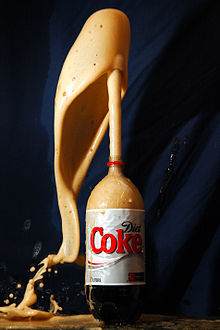
Diet coke and mentos eruption

When the Mentos come into contact with the Coke, a reaction causes the rapid formation of foam.
A 2006 episode of the television series MythBusters concluded that the potassium benzoate, aspartame, and CO2 gas contained in the Diet Coke, in combination with the gelatin and gum arabic ingredients of the Mentos, all contribute to formation of the foam. The structure of the Mentos is the most significant cause of the eruption due to nucleation. MythBusters reported that when fruit-flavored Mentos with a smooth waxy coating were tested in carbonated drink there was hardly a reaction, whereas mint-flavored Mentos (with no such coating) added to carbonated drink formed an energetic eruption, affirming the nucleation-site theory. According to MythBusters, the surface of the mint Mentos is covered with many small holes that increase the surface area available for reaction (and thus the quantity of reagents exposed to each other at any given time), thereby allowing CO2 bubbles to form with the rapidity and quantity necessary for the "jet"- or "geyser"-like nature of the effusion. This hypothesis gained further support when rock salt was used as a "jump start" to the reaction.
A paper by Tonya Coffey, a physicist at Appalachian State University in Boone, North Carolina, goes into detail on the reasons and physics behind the reaction. Coffey found that the rough surface of the Mentos candy helps speed the reaction. Coffey also found that the aspartame in diet soda lowers the surface tension and causes a bigger reaction, but that caffeine does not accelerate the reaction.

BUTTERFLY NEBULA- Beauty at its peak

The bright clusters and nebulae of planet Earth's night sky are often named for flowers or insects. Though its wingspan covers over 3 light-years, NGC 6302 is no exception. With an estimated surface temperature of about 250,000 degrees C, the dying central star of this particular planetary nebula has become exceptionally hot, shining brightly in ultraviolet light but hidden from direct view by a dense torus of dust.

This sharp and colorful close-up of the dying star's nebula was recorded in 2009 by the Hubble Space Telescope's Wide Field Camera 3, installed during the final shuttle servicing mission. Cutting across a bright cavity of ionized gas, the dust torus surrounding the central star is near the center of this view, almost edge-on to the line-of-sight. Molecular hydrogen has been detected in the hot star's dusty cosmic shroud. NGC 6302 lies about 4,000 light-years away in the arachnologically correct constellation of the Scorpion (Scorpius).

Image Credit: NASA/ESA/Hubble

Why do onions make us cry?

Unless you've avoided cooking, you've probably cut up an onion and experienced the burning and tearing you get from the vapors. When you cut an onion, you break cells, releasing their contents. Amino acid sulfoxides form sulfenic acids. Enzymes that were kept separate now are free to mix with the sulfenic acids to produce propanethiol S-oxide, a volatile sulfur compound that wafts upward toward your eyes. This gas reacts with the water in your tears to form sulfuric acid. The sulfuric acid burns, stimulating your eyes to release more tears to wash the irritant away.
Cooking the onion inactivates the enzyme, so while the smell of cooked onions may be strong, it doesn't burn your eyes. Aside from wearing safety goggles or running a fan, you can keep from crying by refrigerating your onion before cutting it (slows reactions and changes the chemistry inside the onion) or by cutting the onion under water.

The sulfur-containing compounds also leave a characteristic odor on your fingers. You may be able to remove or reduce some of the smell by wiping your fingers on a stainless steel odor eater.

Why should we stay awake in math class?


Albert Einstein loved to think about physics, especially about light and about gravity. But he really hated school, and particularly math classes. So a classmate would take notes in math classes for Albert, and then Albert would use them to cram for exams, and that way he could devote the time otherwise "wasted" in math class to thinking about what the world would look like while riding on a beam of light or what it would feel like falling down an elevator shaft (I'm not kidding....). Many years later, Einstein was already famous for his Theory of Special Relativity which explains why light behaves the way it does, when he decided to take on gravity.

Although Newton's theory of gravity explained many questions, such as why the planets move the way they do and why things fall, and made very accurate predictions for experimental observations, there were a few things that were amiss. For some strange reason, the planet Mercury's orbit was a little off from what Newton's gravity predicted for its motion, and a few other little things here and there didn't add up perfectly. But for all practical purposes, Newton's theory of gravity worked very well and was a huge leap forward in our understanding of Nature. Einstein, however, wondered about the little odds and ends that weren't explained by Newton's theory.

For eight years, Einstein did nothing but tinker with Newton's theory of gravity. He had many brilliant insights, but the structure of what he put together was very messy mathematically. There was no tidy way to put down in equations the essential meaning of his new ideas. Then he talked to an old classmate who had taken notes for him in math classes. Einstein explained his new hypothesis about gravity and asked the fellow if he had any ideas about how to structure gravity more clearly mathematically. His friend told him about a discipline of mathematics that had been discovered while they had both been in school — tensor calculus and matrix mechanics in linear algebra. When he heard this, Einstein spent a lot of time slapping himself in the head. This mathematics was not only elegant and beautiful, but it took the untidy equations Einstein had formulated and put them in a structure that was compact, showed relationships easily, and brought elegance and ease of understanding to what later became known as Einstein's General Theory of Relativity. Einstein's General Theory of Relativity boils down to this one equation in the language of tensor calculus:


Einstein later said that had he attended his math classes in school, he would have heard of these new mathematical disciplines, and instead of his theory taking eight years to develop, it would have taken him only three years at most.

Friday, 14 June 2013

Different types of Dry Ice

Dry ice bubbles as it sublimates in colored water. (Anne Helmenstine)
You probably know you can drop dry ice in warm water to make fog, but you might not know there are different types of dry ice. Ideally, 'dry ice' is just another name for solid carbon dioxide, but it's like any other chemical in that it may or may not be 100% pure. Some impurities may be harmless while others may be potentially nasty contaminants. You can use pretty much any dry ice to make smoke or fog for a party effect. You want to use food-grade dry ice if you intend to put the dry ice in drinks or are going to use it to freeze foods. Your supplier should be able to tell you whether your dry ice is food-grade or not.
If you add dry ice directly to drinks some of the carbon dioxide will be dissolved in the liquid in much the same way as some carbon dioxide stays in carbonated beverages even after the fizzing has stopped. This will make the drink more acidic than it would be otherwise, which will affect the flavor slightly. If dry ice is added to a pool or hot tub, you'll want to pay attention to the change in pH because it could impact your water treatment regimen.
Dry ice sinks in water, so it's fairly easy to avoid direct contact if it's in a drink or if you are in a pool with it. When nearly all of the dry ice has sublimated, then water ice forms around it. This ice containing a dry ice core will float to the top of the liquid. It's very cold, so you don't want to drink it or handle it.

Wednesday, 12 June 2013

What happens if you eat Silica Gel?

Silica gel beads (Balanarayanan)
Silica gel beads are found in those little packets accompanying shoes, clothing and some snacks. The packets contain round or granular bits of silica, which is called a gel but is really a solid. The containers typically carry dire "Do Not Eat" and "Keep Away from Children" warnings. So, what happens if you eat silica?
Usually, nothing. In fact, you eat it all the time. Silica is added to improve flow in powdered foods. It occurs naturally in water, where it may help confer resistance against developing senility. Silica is just another name for silicon dioxide, the main component of sand.
Yet, if silica is harmless to eat, why do the packets carry the warning? The answer is that some silica contains toxic additives. For example, silica gel beads may contain toxic and potentially carcinogenic cobalt(II) chloride, which is added as a moisture indicator. You can recognize silica containing cobalt chloride because it will be colored blue (dry) or pink (hydrated). Another common moisture indicator is methyl violet, which is orange (dry) or green (hydrated). Methyl violet is a mutagen and mitotic poison. While you can expect most silica you encounter will be non-toxic, ingestion of a colored product warrants a call to Poison Control.

Monday, 10 June 2013

Its time to go solar!

One reason that solar energy has not been widely adopted is because light absorbing materials are not durable. Materials that harvest solar radiation for energy often overheat or degrade over time; this reduces their viability to compete with other renewable energy sources like wind or hydroelectric generators. A new video protocol addresses these issues by presenting a synthesis of two inorganic nanocrystals, each of which is more durable than their organic counterparts.
The article, published in Journal of Visualized Experiments (JoVE), focuses on the liquid phase synthesis of two nanocrystals that produce hydrogen gas or an electric charge when exposed to light. "The main advantage of this technique is that it allows for direct, all inorganic coupling of the light absorber and the catalyst," says the leading author Dr. Mikhail Zamkov of Bowling Green State University.
Zamkov's nanocrystals are unique for two reasons: they separate charge in different ways due to their architectures, and they are inorganic and durable. The first nanocrystal is rod-shaped, which allows the charge separation needed to produce hydrogen gas, a reaction known as photocatalysis. The second nanocrystal is composed of stacked layers and generates electricity, thus being photovoltaic. Because the nanocrystals are inorganic, they are easier to recharge and less sensitive to heat than their organic counterparts. Zamkov's inorganic photocatalytic material allows a rechargeable reaction when exposed to cheap organic solvents, whereas in traditional photocatalytic reactions the catalyst is often irreversibly degraded. The photovoltaic nanocrystals can also withstand higher heat than the traditional photovoltaic cells that do not dissipate heat well.
"We have established a new method for making photocatalytic and photovoltaic materials. This is important primarily as a new strategy for making photovoltaic films that are 100% inorganic, thus producing a more stable solar panel. It is a design that you could reach marketability," Dr. Zamkov says. "It is important to have these steps documented in a video format, as the synthesis of the photocatalytic nanocrystals and the photovoltaic cells are long procedures with detailed steps. It makes our technique more visible and accessible."

Latest Physics inventions-2012


1) Raytheon's XOS 2 Exoskeleton


The new generation exoskeleton was developed by Raytheon. It allows the user to lift 200 pounds hundreds of times without getting tire. The robotic suit was developed for the U.S. Army.

2) Hair-Washing Machine
Developed by Panasonic, the robot is meant to help caregivers that work in hospitals and health care institutions. It makes use of the company's robot hand technology, featuring 16 fingers used to wash your hair.

3) Visually Impaired Assistant (VIA)
Noam Klopper is the author of the invention for the blind. The device is worn on the hand,
 representing a combination of GPS and walking tick. It includes 4 mini cameras and a GPS
 receiver that allows the wearer to dodge obstacles.

4) Technology that Powers Phones with Sound Waves
Sound energy is the vibrations generated by the sound. Speakers makes use of
 electricity to generate sound, but Korean scientists managed to create a device that
 does the opposite. They came up with a technology that turns sound waves into electricity.

5) Virtual Garage
Developed by Jaguar Land Rover, the Virtual garage is a GBP2.5 million project that
 claims to be the most highly developed virtual reality facility among all car manufacturers.
 The virtual garage technology includes 8 Sony 4K digital camera projectors and
 22 Sun Microsystems advanced PCs.

6) Perpetual Motion Device that Produces Power from Gravity
A Somerset engineers managed to develop a device that literally breaks the
 laws of physics, being
 able to generate more energy that it consumes. Called the Alpha Omega Galaxy Freefall
 Generator, it produces power from perpetual motion. To create the device, the inventor
 used mostly bicycle parts.

7) Flexible See-Through Solar Cells for Windows
At present Eight19 is working on the creation of an organic solar photovoltaic technology.
 The latter could later considerably ease the process of installing solar cells, making it cheaper
 as well. Based on the upper mentioned technology, the new solar panels will be made of a
 flexible see-through material.

8) Tread-Walk to Help the Elderly and Disabled
Being developed for the elderly and disabled, the invention boasts an ease control system
that allows a person to dodge obstacles and avoid collisions. The Tread-Walk is able to
 fulfill the personal mobility needs of these people.

9) Battlefield Extraction-Assist Robot
Created by Vecna Robotics, the machine is meant to carry injured soldiers out of battlefield.
It can also break locked doors and lift heavy cargo.

10) Paper-Based Lithium-Ion Batteries
This invention was developed by Stanford researchers. These ultrathin batteries could
 be used to power electronic newspapers. In addition, researchers will be able to make
 smart packaging that would assist marketers.

Wikipedia in space! Asteroid named after Wikipedia.

Main belt asteroid Number 274301 was officially named after the online encyclopedia, Wikipedia on January 31, 2013. Of course, the name was changed because Main Belt asteroid No. 274301 didn't roll quite off the tongue like Wikipedia does.
However, the official press release from the Andrushivka Astronomical Observatory in Ukraine, the same observatory that found the asteroid belt in 2008, stated that they chose the name Wikipedia to honor a website that can educate people around the world for free.
Not only is Wikipedia a free database of information, it is also one of the most visited websites in the world and can be translated into 270 different languages. All of this was achieved within 11 years after Wikipedia launched!

Read more at http://www.omg-facts.com/category/7/Science#QkTd8rwOyrdM3oFc.99