Showing posts with label chemistry. Show all posts

Monday, 17 June 2013

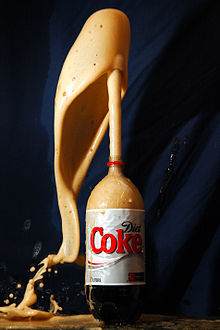
Diet coke and mentos eruption

When the Mentos come into contact with the Coke, a reaction causes the rapid formation of foam.
A 2006 episode of the television series MythBusters concluded that the potassium benzoate, aspartame, and CO2 gas contained in the Diet Coke, in combination with the gelatin and gum arabic ingredients of the Mentos, all contribute to formation of the foam. The structure of the Mentos is the most significant cause of the eruption due to nucleation. MythBusters reported that when fruit-flavored Mentos with a smooth waxy coating were tested in carbonated drink there was hardly a reaction, whereas mint-flavored Mentos (with no such coating) added to carbonated drink formed an energetic eruption, affirming the nucleation-site theory. According to MythBusters, the surface of the mint Mentos is covered with many small holes that increase the surface area available for reaction (and thus the quantity of reagents exposed to each other at any given time), thereby allowing CO2 bubbles to form with the rapidity and quantity necessary for the "jet"- or "geyser"-like nature of the effusion. This hypothesis gained further support when rock salt was used as a "jump start" to the reaction.
A paper by Tonya Coffey, a physicist at Appalachian State University in Boone, North Carolina, goes into detail on the reasons and physics behind the reaction. Coffey found that the rough surface of the Mentos candy helps speed the reaction. Coffey also found that the aspartame in diet soda lowers the surface tension and causes a bigger reaction, but that caffeine does not accelerate the reaction.

Why do onions make us cry?

Unless you've avoided cooking, you've probably cut up an onion and experienced the burning and tearing you get from the vapors. When you cut an onion, you break cells, releasing their contents. Amino acid sulfoxides form sulfenic acids. Enzymes that were kept separate now are free to mix with the sulfenic acids to produce propanethiol S-oxide, a volatile sulfur compound that wafts upward toward your eyes. This gas reacts with the water in your tears to form sulfuric acid. The sulfuric acid burns, stimulating your eyes to release more tears to wash the irritant away.
Cooking the onion inactivates the enzyme, so while the smell of cooked onions may be strong, it doesn't burn your eyes. Aside from wearing safety goggles or running a fan, you can keep from crying by refrigerating your onion before cutting it (slows reactions and changes the chemistry inside the onion) or by cutting the onion under water.

The sulfur-containing compounds also leave a characteristic odor on your fingers. You may be able to remove or reduce some of the smell by wiping your fingers on a stainless steel odor eater.

Friday, 14 June 2013

Different types of Dry Ice

Dry ice bubbles as it sublimates in colored water. (Anne Helmenstine)
You probably know you can drop dry ice in warm water to make fog, but you might not know there are different types of dry ice. Ideally, 'dry ice' is just another name for solid carbon dioxide, but it's like any other chemical in that it may or may not be 100% pure. Some impurities may be harmless while others may be potentially nasty contaminants. You can use pretty much any dry ice to make smoke or fog for a party effect. You want to use food-grade dry ice if you intend to put the dry ice in drinks or are going to use it to freeze foods. Your supplier should be able to tell you whether your dry ice is food-grade or not.
If you add dry ice directly to drinks some of the carbon dioxide will be dissolved in the liquid in much the same way as some carbon dioxide stays in carbonated beverages even after the fizzing has stopped. This will make the drink more acidic than it would be otherwise, which will affect the flavor slightly. If dry ice is added to a pool or hot tub, you'll want to pay attention to the change in pH because it could impact your water treatment regimen.
Dry ice sinks in water, so it's fairly easy to avoid direct contact if it's in a drink or if you are in a pool with it. When nearly all of the dry ice has sublimated, then water ice forms around it. This ice containing a dry ice core will float to the top of the liquid. It's very cold, so you don't want to drink it or handle it.

Wednesday, 12 June 2013

What happens if you eat Silica Gel?

Silica gel beads (Balanarayanan)
Silica gel beads are found in those little packets accompanying shoes, clothing and some snacks. The packets contain round or granular bits of silica, which is called a gel but is really a solid. The containers typically carry dire "Do Not Eat" and "Keep Away from Children" warnings. So, what happens if you eat silica?
Usually, nothing. In fact, you eat it all the time. Silica is added to improve flow in powdered foods. It occurs naturally in water, where it may help confer resistance against developing senility. Silica is just another name for silicon dioxide, the main component of sand.
Yet, if silica is harmless to eat, why do the packets carry the warning? The answer is that some silica contains toxic additives. For example, silica gel beads may contain toxic and potentially carcinogenic cobalt(II) chloride, which is added as a moisture indicator. You can recognize silica containing cobalt chloride because it will be colored blue (dry) or pink (hydrated). Another common moisture indicator is methyl violet, which is orange (dry) or green (hydrated). Methyl violet is a mutagen and mitotic poison. While you can expect most silica you encounter will be non-toxic, ingestion of a colored product warrants a call to Poison Control.

Tuesday, 11 June 2013

Unfrozen Mystery: H2O Reveals a New Secret

Their work is published in theProceedings of the National Academy of Sciences.
When water freezes into ice, its molecules are bound together in a crystalline lattice held together by hydrogen bonds. Hydrogen bonds are highly versatile and, as a result, crystalline ice reveals a striking diversity of at least 16 different structures.
In all of these forms of ice, the simple H2O molecule is the universal building block. However, in 1964 it was predicted that, under sufficient pressure, the hydrogen bonds could strengthen to the point where they might actually break the water molecule apart. The possibility of directly observing a disassociated water molecule in ice has proven a fascinating lure for scientists and has driven extensive research for the last 50 years. In the mid-1990s several teams, including a Carnegie group, observed the transition using spectroscopic techniques. However, these techniques are indirect and could only reveal part of the picture.
A preferred method is to "see" the hydrogen atoms-or protons-directly. This can be done by bouncing neutrons off the ice and then carefully measuring how they are scattered. However, applying this technique at high enough pressures to see the water molecule dissociate had simply not been possible in the past. Guthrie explained that: "you can only reach these extreme pressures if your samples of ice are really small. But, unfortunately, this makes the hydrogen atoms very hard to see."
The Spallation Neutron Source was opened at Oak Ridge National Laboratory in Tennessee in 2006, providing a new and intensely bright supply of neutrons. By designing a new class of tools that were optimized to exploit this unrivalled flux of neutrons, Guthrie and his team-Carnegie's Russell Hemley, Reinhard Boehler, and Kuo Li, as well as Chris Tulk, Jamie Molaison, and António dos Santos of Oak Ridge National Laboratory-have obtained the first glimpse of the hydrogen atoms themselves in ice at unprecedented pressures of over 500,000 times atmospheric pressure.
"The neutrons tell us a story that the other techniques could not," said Hemley, director of Carnegie's Geophysical Laboratory. "The results indicate that dissociation of water molecules follows two different mechanisms. Some of the molecules begin to dissociate at much lower pressures and via a different path than was predicted in the classic 1964 paper."
"Our data paint an altogether new picture of ice," Guthrie commented. "Not only do the results have broad consequences for understanding bonding in H2O, the observations may also support a previously proposed theory that the protons in ice in planetary interiors can be mobile even while the ice remains solid."
And this startling discovery may prove to be just the beginning of scientific discovery. Tulk emphasized "being able to 'see' hydrogen with neutrons isn't just important for studies of ice. This is a game-changing technical breakthrough. The applications could extend to systems that are critical to societal challenges, such as energy. For example, the technique can yield greater understanding of methane-containing clathrate hydrates and even hydrogen storage materials that could one day power automobiles."
The group is part of Energy Frontier Research in Extreme Environments (EFree), an Energy Frontier Research Center headquartered at Carnegie's Geophysical Laboratory.
Monday, 10 June 2013

Its time to go solar!

One reason that solar energy has not been widely adopted is because light absorbing materials are not durable. Materials that harvest solar radiation for energy often overheat or degrade over time; this reduces their viability to compete with other renewable energy sources like wind or hydroelectric generators. A new video protocol addresses these issues by presenting a synthesis of two inorganic nanocrystals, each of which is more durable than their organic counterparts.
The article, published in Journal of Visualized Experiments (JoVE), focuses on the liquid phase synthesis of two nanocrystals that produce hydrogen gas or an electric charge when exposed to light. "The main advantage of this technique is that it allows for direct, all inorganic coupling of the light absorber and the catalyst," says the leading author Dr. Mikhail Zamkov of Bowling Green State University.
Zamkov's nanocrystals are unique for two reasons: they separate charge in different ways due to their architectures, and they are inorganic and durable. The first nanocrystal is rod-shaped, which allows the charge separation needed to produce hydrogen gas, a reaction known as photocatalysis. The second nanocrystal is composed of stacked layers and generates electricity, thus being photovoltaic. Because the nanocrystals are inorganic, they are easier to recharge and less sensitive to heat than their organic counterparts. Zamkov's inorganic photocatalytic material allows a rechargeable reaction when exposed to cheap organic solvents, whereas in traditional photocatalytic reactions the catalyst is often irreversibly degraded. The photovoltaic nanocrystals can also withstand higher heat than the traditional photovoltaic cells that do not dissipate heat well.
"We have established a new method for making photocatalytic and photovoltaic materials. This is important primarily as a new strategy for making photovoltaic films that are 100% inorganic, thus producing a more stable solar panel. It is a design that you could reach marketability," Dr. Zamkov says. "It is important to have these steps documented in a video format, as the synthesis of the photocatalytic nanocrystals and the photovoltaic cells are long procedures with detailed steps. It makes our technique more visible and accessible."